Hay Guide Charts are essential tools for livestock managers, providing a visual representation of forage quality. They simplify complex nutritional data, aiding informed decisions.
What is a Hay Guide Chart?
A Hay Guide Chart is a graphical representation used to categorize hay based on its nutritional value. It’s not simply a visual inspection tool, but a system built upon laboratory analysis of hay samples. Typically, these charts plot Relative Forage Quality (RFQ) against Dry Matter Digestibility (DMD), though other parameters like Neutral Detergent Fiber (NDF) and protein content can also be incorporated.
The chart visually displays different hay types – such as grass hay, legume hay (like alfalfa), or mixed hay – and positions them according to their analytical results. This allows producers to quickly assess the quality of their hay and compare different cuttings or sources. The chart isn’t static; it’s a dynamic tool that reflects the variability inherent in hay production.
Essentially, it translates complex lab data into an easily understandable format, helping farmers and ranchers make informed decisions about feeding their livestock. It’s a cornerstone of forage management, promoting efficient and cost-effective animal nutrition.
Why Use a Hay Guide Chart?
Utilizing a Hay Guide Chart offers numerous benefits for livestock producers. Primarily, it moves feeding decisions beyond subjective assessment – color, smell, or leafiness – towards objective, scientifically-backed data. This precision minimizes waste and maximizes animal performance.
Charts facilitate accurate ration balancing, ensuring livestock receive the appropriate nutrients for their specific needs, whether it’s growing calves, lactating cows, or performance horses. By understanding the nutritional profile of their hay, producers can strategically supplement diets, reducing feed costs and improving overall profitability.
Furthermore, charts aid in hay marketing, providing a standardized way to evaluate and price forage. They also support informed purchasing decisions, allowing buyers to confidently select hay that meets their livestock’s requirements. Ultimately, a Hay Guide Chart empowers producers to optimize forage utilization and enhance animal health and productivity.
Understanding Hay Quality
Hay quality directly impacts livestock health and performance. Assessing factors like fiber content, protein levels, and digestibility is crucial for optimal animal nutrition.
Key Factors in Hay Quality
Several interconnected factors determine the nutritional value of hay, and therefore, its placement on a Hay Guide Chart. Dry matter content is fundamental; lower moisture levels prevent spoilage and concentrate nutrients. Protein levels, crucial for growth and maintenance, vary significantly with grass and legume types, and maturity at harvest.
Fiber content, specifically Neutral Detergent Fiber (NDF) and Acid Detergent Fiber (ADF), impacts digestibility. Lower ADF generally indicates higher digestibility. Energy content, measured in Megacalories (Mcal), dictates how much fuel the hay provides. Mineral and vitamin composition, though often present in smaller quantities, are vital for overall health.
Leaf-to-stem ratio is also important; leaves are richer in nutrients than stems. Finally, absence of mold, dust, or weeds ensures palatability and prevents health issues. Understanding these factors allows for accurate interpretation of a hay sample’s position on the chart, and informed feeding strategies.
Visual Assessment of Hay
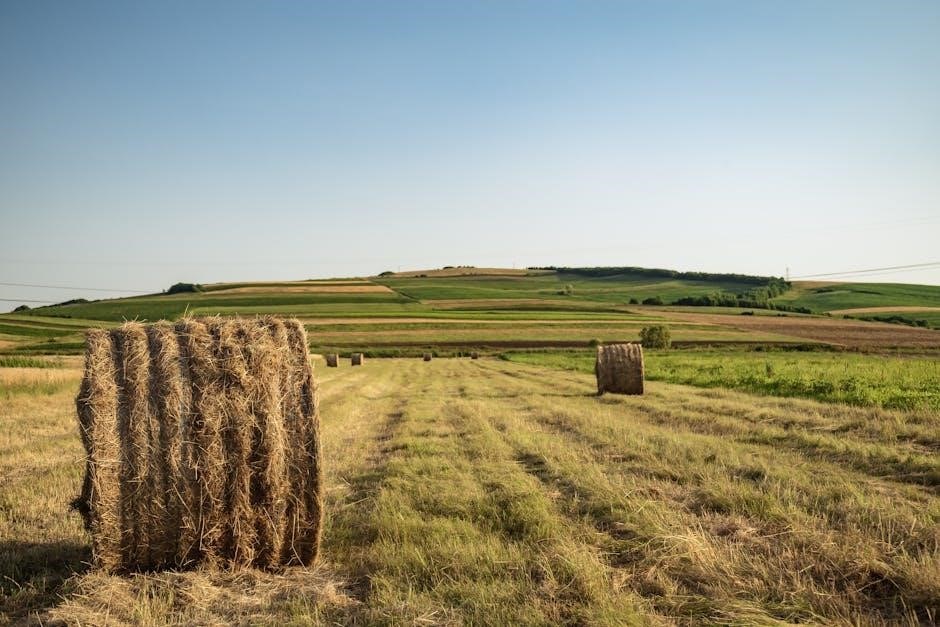
Before relying on a Hay Guide Chart based on lab analysis, a preliminary visual assessment provides valuable initial insights. Color is a key indicator; bright green generally suggests proper curing and retained nutrients, while brown or black indicates potential spoilage. Examine for leafiness – more leaves usually mean higher protein content and palatability.
Stem thickness can suggest maturity; thinner stems indicate earlier cutting and potentially higher quality. Texture should be pliable, not brittle or dusty. Smell the hay – a fresh, sweet aroma is desirable, while musty or moldy odors signal contamination. Look closely for foreign materials like weeds, sticks, or plastic.
Assess the bale’s condition; tight, well-formed bales minimize losses. While visual assessment isn’t a substitute for lab testing, it helps quickly identify potentially problematic hay and prioritize samples for detailed analysis, ultimately informing chart interpretation.
Laboratory Analysis of Hay
While a Hay Guide Chart offers a general framework, accurate forage evaluation demands laboratory analysis. Key parameters include Dry Matter (DM), crucial for calculating intake, and Crude Protein (CP), essential for growth and maintenance. Acid Detergent Fiber (ADF) and Neutral Detergent Fiber (NDF) indicate digestibility – lower values generally mean better utilization.
Total Digestible Nutrients (TDN) provides an overall energy estimate, while Relative Forage Quality (RFQ) combines ADF, NDF, and CP into a single, easily comparable value. Mineral analysis, assessing calcium, phosphorus, and magnesium, is vital for livestock health.
Results from the lab are then plotted onto a Hay Guide Chart, providing a precise location for the hay’s nutritional profile. This data-driven approach ensures accurate ration balancing and optimizes livestock performance, far exceeding the accuracy of visual assessment alone. Choose a reputable lab for reliable results.

Decoding the Hay Guide Chart
Hay Guide Charts visually represent forage quality, using digestible energy and protein content. Understanding these axes unlocks the chart’s power for livestock feeding.
Understanding the Chart’s Axes
Hay Guide Charts primarily utilize two key axes to categorize and evaluate hay quality: Relative Forage Quality (RFQ) and Dry Matter Digestibility (DMD). The RFQ axis, typically displayed vertically, represents the overall nutritional value of the hay for livestock, factoring in both intake potential and nutrient content. Higher RFQ values indicate more digestible and palatable forage.
The horizontal axis usually showcases either Dry Matter Digestibility (DMD) or Net Energy for Maintenance (NEM). DMD signifies the percentage of the hay’s dry matter that an animal can digest, directly correlating to energy availability. NEM, conversely, estimates the energy required to maintain a typical animal of a specific size.
Understanding the scale of each axis is crucial. Values are often expressed as percentages for DMD and as megacalories (Mcal) per pound of dry matter for energy values. These axes aren’t independent; a positive correlation generally exists – as DMD increases, so does RFQ and often NEM. Properly interpreting these axes allows for accurate hay assessment and informed feeding strategies.
Identifying Hay Types on the Chart
Hay Guide Charts visually categorize various hay types based on their RFQ and DMD values. Generally, legume hays – like alfalfa and clover – occupy the upper-left quadrant, boasting high RFQ and DMD due to their rapid digestibility and protein content. Grass hays, such as Timothy, Orchardgrass, and Brome, typically fall lower and to the right, exhibiting lower RFQ and DMD, but providing valuable fiber.
Mature grass hays, harvested later in the season, will cluster towards the lower-right, indicating lower nutritional value. Early-cut grass hays, however, can approach the quality of legume hays. Mixed hay, a blend of grasses and legumes, will position itself somewhere between these extremes, depending on the proportion of each.
The chart allows quick identification: premium hay for performance horses will be high RFQ, while maintenance hay for mature cattle will be lower. Recognizing these patterns simplifies selecting appropriate hay for specific livestock needs and optimizing feed efficiency.
Reading Nutrient Values
Hay Guide Charts don’t just show where a hay type falls, but also provide associated nutrient values. Relative Forage Quality (RFQ) – a key indicator – estimates digestibility for livestock, with higher numbers signifying better quality. Digestible Matter (DMD) represents the percentage of the hay that an animal can actually digest and utilize for energy.
Charts often include approximate Crude Protein (CP) percentages, crucial for growth and lactation. Fiber content, expressed as Neutral Detergent Fiber (NDF) and Acid Detergent Fiber (ADF), impacts intake and digestion; lower ADF generally means higher digestibility.
Understanding these values is vital. For example, a hay with 60% RFQ and 55% DMD offers more energy than one at 40% RFQ and 40% DMD. Charts frequently display ranges for each nutrient, allowing you to assess the variability within a hay type and make informed feeding decisions based on your livestock’s requirements.
Matching Hay to Livestock Needs
Hay Guide Charts help align forage quality with animal demands. Different livestock – horses, cattle, sheep, and goats – have varying nutritional requirements for optimal health.
Hay for Horses
Hay Guide Charts are particularly crucial when selecting forage for horses, as their digestive systems are sensitive and require consistent quality. Horses need a fiber-rich diet to maintain gut health and prevent issues like colic or laminitis.
Generally, horses benefit from hay falling within the intermediate range of the chart – typically late-cut grass hays or first-cut alfalfa blends. These provide adequate energy and protein for maintenance or light to moderate work. However, the specific needs depend heavily on the horse’s age, workload, and metabolic status.
For performance horses or those with higher energy demands, a higher-quality hay, potentially including more alfalfa, is necessary. Conversely, easy keepers or horses prone to weight gain require lower-energy grass hays. Always consider the Non-Structural Carbohydrate (NSC) levels, especially for horses with metabolic concerns like insulin resistance. Utilizing the Hay Guide Chart allows owners to pinpoint hays with appropriate NSC values.
Regularly assessing hay quality using a chart ensures horses receive a balanced diet, supporting their overall well-being and performance.
Hay for Cattle
Hay Guide Charts are invaluable for cattle producers, enabling efficient and cost-effective feeding strategies. Cattle have varying nutritional requirements based on their life stage – growing calves, breeding stock, or finishing animals – and the chart helps match hay quality to these needs.
Mature cows generally thrive on moderate-quality grass hays, positioned in the central portion of the chart. These provide sufficient energy and protein for maintenance and reproduction. However, during late gestation or lactation, their energy demands increase, necessitating higher-quality hay or supplementation.
Growing calves require higher protein levels for optimal development, making legume hays like alfalfa, found towards the upper end of the Hay Guide Chart, a suitable choice. Finishing cattle benefit from energy-dense hays to promote weight gain. Utilizing the chart’s data on TDN (Total Digestible Nutrients) and protein content is crucial.
Producers can minimize feed costs by selecting the lowest-cost hay that meets the cattle’s nutritional requirements, as determined by careful chart analysis.
Hay for Sheep and Goats
Hay Guide Charts are particularly useful for sheep and goat producers due to their selective feeding habits and diverse nutritional needs. Both species prefer different forage textures and nutrient levels depending on their physiological state.
Sheep, especially those being prepared for breeding or lactation, benefit from higher-quality legume hays like alfalfa or clover, typically found in the upper regions of the Hay Guide Chart. These provide the necessary protein and energy for reproductive success.
Goats, known for their browsing tendencies, often prefer a mix of grasses and forbs. While they can utilize grass hays, they generally require a higher concentration of nutrients than sheep, making moderate-quality legume-grass mixes ideal. The chart assists in identifying hays with appropriate fiber and nutrient profiles.
Young, growing lambs and kids require high-protein hays for rapid development. Careful consideration of the chart’s protein and TDN values ensures optimal growth rates. Utilizing the chart helps avoid costly over-supplementation or nutritional deficiencies.
Using the Chart for Ration Balancing
Hay Guide Charts facilitate precise ration balancing by revealing nutrient content. Combining chart data with livestock needs ensures optimal health and performance efficiently.
Calculating Dry Matter Intake
Dry Matter Intake (DMI) is a crucial calculation when utilizing a Hay Guide Chart for ration balancing. It represents the amount of feed an animal consumes, excluding water content. Accurately determining DMI is vital for ensuring livestock receive adequate nutrition.
To calculate DMI, begin by knowing your animal’s body weight. A general rule of thumb is that livestock consume approximately 2-3% of their body weight in dry matter per day, though this varies based on species, age, physiological state (e.g., lactation, gestation), and activity level.
Next, determine the moisture content of the hay. This is often found through laboratory analysis, but estimations can be made based on visual assessment and hay type. Subtract the moisture percentage from 100% to find the dry matter percentage. For example, hay with 15% moisture contains 85% dry matter.
Finally, multiply the animal’s body weight (in pounds) by the DMI percentage (as a decimal) and then divide by the hay’s dry matter percentage (as a decimal). This yields the amount of hay, in pounds, needed to meet the animal’s daily DMI requirement. Using the Hay Guide Chart alongside this calculation ensures the hay provides the necessary nutrients.
Adjusting Rations Based on Hay Analysis
Once you’ve obtained a laboratory analysis of your hay and referenced its position on the Hay Guide Chart, ration adjustments are often necessary to meet livestock nutritional needs. The chart provides a baseline, but individual animal requirements vary.
If the hay analysis reveals deficiencies in key nutrients – like protein or energy – supplementation is crucial. Common supplements include grains, protein meals, or mineral blocks. The Hay Guide Chart helps quantify the extent of supplementation needed.
Conversely, if the hay is exceptionally high in certain nutrients, you might reduce concentrate supplementation to avoid overfeeding. Overfeeding can lead to metabolic issues and wasted resources.
Carefully compare the hay’s nutrient profile to the animal’s requirements (based on species, age, and production stage). Use ration balancing software or consult with an animal nutritionist to formulate a precise diet. Regularly monitor animal condition and adjust the ration accordingly, continually referencing the Hay Guide Chart as a valuable tool.
Supplementation Considerations
When using a Hay Guide Chart to inform supplementation, several factors beyond simple nutrient deficiencies must be considered. The bioavailability of nutrients within the hay itself plays a role; some nutrients are more readily digestible than others.
Supplement type matters. Choose supplements that complement the hay’s existing nutrient profile, avoiding imbalances. For example, pairing low-protein hay with a protein-rich supplement, but also considering mineral ratios.
Consider the animal’s digestive capacity. Rapid changes in diet can disrupt gut health. Introduce supplements gradually to allow for microbial adaptation. The Hay Guide Chart helps anticipate these needs.
Cost-effectiveness is vital. Evaluate the price per unit of nutrient provided by different supplements. Don’t automatically assume the most expensive option is the best. Finally, always provide clean, fresh water, as it’s essential for nutrient absorption and overall health, working in tandem with the Hay Guide Chart’s insights.
Advanced Hay Guide Chart Applications
Hay Guide Charts facilitate nuanced analysis, revealing impacts of cutting dates and weather. Optimize feeding strategies and maximize cost-efficiency through detailed chart interpretation.
Evaluating Different Cutting Dates
Hay Guide Charts become particularly valuable when assessing the impact of varying harvest times. First cuttings, typically harvested in late spring, generally yield higher volumes but possess lower nutritional value – higher fiber content and lower protein – as the plants are more mature. The chart will visually demonstrate this, positioning first-cutting hay lower on the quality spectrum.
Second cuttings, taken in mid-summer, offer a sweet spot, balancing yield and quality. They exhibit higher protein and digestible energy, reflected by a more favorable placement on the Hay Guide Chart. However, yields are usually lower than first cuttings.
Third cuttings, if feasible depending on climate and regrowth potential, represent the highest quality, with the most digestible nutrients. These will appear highest on the chart, but are often limited in quantity. By comparing samples from each cutting on the chart, producers can strategically plan harvests to meet specific livestock needs throughout the year, optimizing both feed efficiency and animal performance. Understanding these shifts allows for informed decisions regarding supplementation and overall forage management.
Impact of Weather on Hay Quality & Chart Placement
Hay Guide Charts vividly illustrate how weather profoundly influences forage quality. Prolonged periods of rain during cutting or drying can lead to leaf loss, reducing nutrient content and increasing the risk of mold growth. This degradation shifts the hay’s position downwards on the chart, indicating lower overall quality.
Conversely, optimal conditions – sunny days with low humidity – promote efficient drying, preserving leaf retention and maximizing nutrient concentration. Such hay will be positioned higher on the Hay Guide Chart, reflecting its superior nutritional profile.
Excessive moisture also impacts fermentation during storage, potentially leading to spoilage and further quality decline. Drought conditions, while facilitating drying, can result in stressed plants with reduced vigor and lower nutrient levels. Producers can use the chart to compare hay from different years, noting how weather patterns affected quality and adjusting feeding strategies accordingly. Careful monitoring and timely harvesting are crucial for maximizing forage value.
Using Charts for Cost-Effective Feeding
Hay Guide Charts empower producers to make financially sound feeding decisions. By accurately assessing hay quality, you can avoid over-supplementing livestock with expensive concentrates when forage already meets their nutritional needs. This minimizes feed costs and maximizes profitability.
The chart helps identify lower-quality hay that requires supplementation, preventing nutrient deficiencies and ensuring animal health. Conversely, high-quality hay may reduce or eliminate the need for costly additions. Understanding the chart’s nutrient values allows for precise ration balancing, optimizing feed efficiency.
Comparing hay prices alongside chart placements reveals true value. A cheaper hay isn’t always the best deal if its lower quality necessitates substantial supplementation. Utilizing the Hay Guide Chart facilitates informed purchasing, ensuring you get the most nutritional bang for your buck, ultimately boosting your bottom line and improving livestock performance.
Resources and Further Information
Hay Guide Charts and analysis resources are widely available. Explore online tools and connect with local experts for detailed guidance on forage management.
Online Hay Guide Chart Tools
Several excellent online resources provide interactive Hay Guide Charts and related information. These tools often allow users to input hay analysis results – such as protein, fiber, and energy content – to pinpoint the hay’s position on the chart. This visual representation instantly clarifies the hay’s quality tier and suitability for different livestock.
Many university extension programs host online charts, frequently updated with regional data. These are often free to use and offer detailed explanations of chart interpretation. Commercial forage testing laboratories also commonly provide digital chart access alongside their analysis reports, streamlining the process of matching hay to animal needs.
Furthermore, some websites offer downloadable chart templates for manual plotting, while others feature mobile applications for convenient field use. When selecting an online tool, consider its user-friendliness, data input options, and the clarity of its visual presentation. Regularly verifying the source and update frequency of the chart data is also crucial for accurate assessments.
Local Extension Office Resources
Your local County Extension Office is an invaluable, often underutilized, resource for understanding and utilizing Hay Guide Charts. Extension agents possess localized knowledge of regional forage production, common hay types, and typical nutrient profiles within your area. They can provide printed charts specifically calibrated for your region’s grasses and legumes.
Beyond simply providing the chart, Extension agents offer personalized assistance. They can help you interpret your hay analysis results, accurately plot your hay on the chart, and determine its suitability for your livestock. Many offices also host workshops and training sessions on forage management, including detailed instruction on chart usage.
Furthermore, Extension offices frequently collaborate with local forage testing laboratories, offering convenient sample submission and result interpretation services. They can also connect you with local producers and experts for peer-to-peer learning and best practice sharing. Don’t hesitate to contact your local office – their expertise is readily available and often free of charge!
Further Reading on Hay Analysis
A deeper understanding of hay analysis is crucial for maximizing the benefits of Hay Guide Charts. The Forage Information System (FIS) maintained by the University of Wisconsin-Madison (fisp.cals.wisc.edu) provides comprehensive information on forage testing procedures and interpretation.
The American Forage and Grassland Council (www.afgc.org) offers numerous publications and resources on forage production, quality assessment, and nutritional management. Look for their guides on interpreting lab reports and selecting appropriate hay for different livestock classes.
Several university extension websites, such as those from Penn State and Michigan State, feature detailed articles and fact sheets on hay analysis, including explanations of key parameters like NDF, ADF, and relative forage quality (RFQ). Exploring these resources will empower you to confidently utilize Hay Guide Charts and optimize your livestock’s nutrition.